
Macro Calculator: Dial in Protein, Carbs & Fat
Macros are protein, carbohydrate and fat, the three nutrients that supply your calories: 4 kcal per gram for protein and carbs, 9 for fat. Enter your details to get a daily calorie target, then pick how to split it into grams. The guide below shows the same maths step by step.
Balanced Diet
30% protein, 40% carbs, 30% fat. A middle-of-the-road split for most people.
Macro Calculator
Calculate grams of protein, carbs & fat
Your baseline TDEE is 2,678 kcal.
Meal-by-Meal Macro Distribution
Recommended macronutrient targets divided by your preferred meal frequency.
Real Food Macro Ingredients
How much protein, carbohydrate or fat a few staples carry, per 100 g unless noted.
Lean Protein Sources
Build & Retain Muscle- Chicken Breast (Skinless, Cooked)31g P / 100g
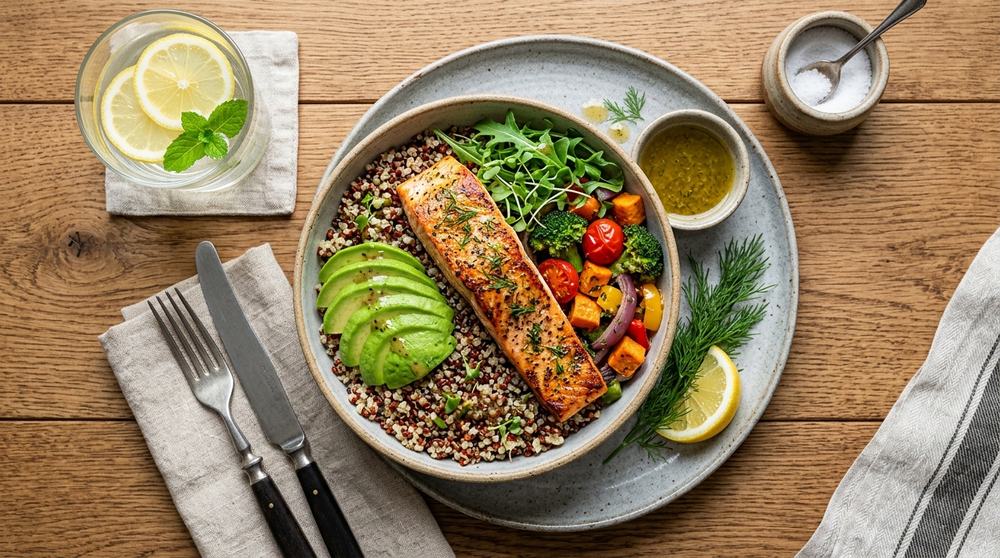
- Wild Atlantic Salmon (Cooked)25g P / 100g
- 0% Greek Yogurt10g P / 100g
- Whole Eggs (About 2 Large)13g P / 100g
Complex Carbohydrates
Training & Glycogen Fuel- Rolled Oats (Raw)66g C / 100g
- Jasmine / Basmati Rice (Cooked)28g C / 100g
- Baked Sweet Potato21g C / 100g
- Fresh Blueberries14g C / 100g
Healthy Dietary Fats
Hormone & Joint Health- Extra Virgin Olive Oil (1 tbsp)14g F / 15ml
- Fresh Avocado15g F / 100g
- Raw Almonds50g F / 100g
- Peanut Butter (2 tbsp)16g F / 32g
Rounded values based on USDA FoodData Central entries. Farmed salmon is closer to 22 g protein per 100 g, and walnuts carry about 65 g fat per 100 g. Brands and cooking methods vary, so use the label when you have one.
How to Calculate Macros
Basal metabolic rate (BMR) is the calories your body burns at complete rest, before walking, training or digesting food. This free macro calculator estimates that BMR with the Mifflin-St Jeor equation, multiplies it by your activity level to get total daily energy expenditure (TDEE), then splits the TDEE into protein, carbohydrate and fat. It runs in the browser. No account is required.
- Find your basal metabolic rate: BMR is the resting number. Mifflin-St Jeor calculates it as (10 × weight in kg) + (6.25 × height in cm) − (5 × age) + 5 for men, or −161 for women.
- Turn that BMR into daily calories: Multiply BMR by the activity level you select. The rounded result is your TDEE, the calories for a full day. Maintenance keeps that TDEE. Lose Fat subtracts 500 kcal. Build Mass adds 400 kcal. The calorie calculator subtracts the same 500 kcal on its Moderate pace, but adds 500 kcal for Build Mass and also offers 250 and 750 kcal paces.
- Split those calories into macros: Five presets are a protein, carb and fat percentage: balanced 30/40/30, low carb 40/20/40, high carb 30/50/20, keto 25/5/70, and bodybuilder 40/35/25. The sixth, Protein by Body Weight, sets protein in grams per kilogram instead.
- Convert each share into grams: Protein and carbohydrate are 4 kcal per gram. Fat is 9 kcal per gram. Each share is rounded on its own, so the three calorie figures can sit 1 kcal off the daily target.
The activity choice moves the whole result. The same opening person at Lightly Active (× 1.375) has a TDEE of 2,375 kcal instead of 2,678. On the balanced preset that is 178 g protein, 238 g carbs and 79 g fat. The equation did not change.
Worked example with the form defaults
The form opens on a 28-year-old man, 75 kg, 178 cm, Moderately Active (× 1.55), Maintain, and Balanced. BMR is (10 × 75) + (6.25 × 178) − (5 × 28) + 5 = 1,727.5 kcal. Times 1.55, rounded, is 2,678 kcal.
Balanced takes 30% protein, 40% carbs and 30% fat. That is 803 kcal, 1,071 kcal and 803 kcal, which converts to 201 g protein, 268 g carbs and 89 g fat. At 75 kg, 201 g is 2.7 g per kilogram. The result card prints that grams-per-kilogram figure so you can see it.
Three meals, the default split, puts 30% at breakfast and 35% each at lunch and dinner. Breakfast on this day is 803 kcal, 60 g protein, 80 g carbs and 27 g fat. Lunch and dinner are each 937 kcal, 70 g protein, 94 g carbs and 31 g fat.
How to calculate macros for weight loss
To calculate macros for weight loss, subtract 500 kcal from your TDEE, then apply the preset. For the opening inputs the fat-loss target is 2,178 kcal: 163 g protein, 218 g carbs and 73 g fat on Balanced. That is 2.2 g of protein per kilogram. Choose Lose Fat on the form to get this target.
A deficit of 500 kcal a day is the usual rough guide to about one pound (about 0.45 kg) a week, because a pound of body tissue is often treated as 3,500 kcal. Real weekly change also depends on water, the activity guess, and how closely the food log matches the target. Recalculate after a few kilograms of weight change, or when training volume changes.
The Bodybuilder preset on the same 2,178 kcal day is 40/35/25, which comes out to 218 g protein, 191 g carbs and 61 g fat (2.9 g/kg). That higher protein number is what 40% of the calories produces. It is not a separate gram-per-kilo rule. When calories and protein are matched, low-carb and high-carb presets are not expected to change fat loss by much. Use the preset you can keep eating.
Macro calculator for women
A macro calculator for women uses the same age, height, weight and activity, and changes one number in the basal metabolic rate equation: −161 instead of +5. Height, weight, age and activity still drive the result, so two people of different sexes with the same stats do not get the same calories. Choose Female on the form.
A 30-year-old woman, 65 kg, 165 cm, Moderately Active: BMR is (10 × 65) + (6.25 × 165) − (5 × 30) − 161 = 1,370.25 kcal. Times 1.55, rounded, is a TDEE of 2,124 kcal. Maintenance on Balanced is 159 g protein, 213 g carbs and 71 g fat (2.4 g/kg).
Lose Fat for the same woman is 2,124 − 500 = 1,624 kcal, or 122 g protein, 163 g carbs and 54 g fat. That protein target is 1.9 g/kg, inside the 1.6–2.2 g/kg band many lifters use as a check. The Bodybuilder preset on that same 1,624 kcal day is 163 g protein, 142 g carbs and 45 g fat (2.5 g/kg).
Macros for muscle gain
Macros for muscle gain add 400 kcal to TDEE, then split that higher target. The opening man goes from 2,678 to 3,078 kcal. Choose Build Mass on the form. Balanced then reads 231 g protein, 308 g carbs and 103 g fat. The high-carb preset (30/50/20) leaves more of that surplus for training days. The bodybuilder preset (40/35/25) on 3,078 kcal is 308 g protein, which is 4.1 g/kg. That is above the 1.6–2.2 g/kg range that covers most of the muscle-building benefit. Read the g/kg line on the card. If it is far above that range, Balanced or High Carb still feeds the surplus without pushing protein that high.
Macros to lose fat and build muscle at the same time
Losing fat while gaining muscle, often called body recomposition, needs a calorie deficit, hard resistance training and high protein together. In a four-week trial, 40 young men ate about 40% below their energy needs and trained six days a week. The group eating 2.4 g of protein per kilogram gained 1.2 kg of lean mass and lost 4.8 kg of fat, while the 1.2 g/kg group gained 0.1 kg of lean mass and lost 3.5 kg of fat (Longland et al., 2016). That was a short study in young men on a demanding programme, so treat it as proof that it can happen, not a promised rate.
On this calculator, choose Lose Fat and Protein by Body Weight at 2.2 g/kg. For the opening man that is 2,178 kcal: 165 g protein, 243 g carbs and 61 g fat. Keep lifting, and judge progress by strength and waist measurement as well as the scale.
Protein by body weight
Choose Protein by Body Weight and pick 1.6, 2.0 or 2.2 g/kg. Protein is that number times your weight in kilograms, at 4 kcal per gram. Fat is 25% of the calorie target, at 9 kcal per gram. Carbohydrate is whatever calories are left, at 4 kcal per gram. If protein and fat would use up the whole target, carbs stay at zero and fat shrinks to fit.
For the opening man at 2.0 g/kg, protein is 2.0 × 75 = 150 g (600 kcal). On the 2,678 kcal maintenance day, fat is 670 kcal, or 74 g, and carbs are 2,678 − 600 − 670 = 1,408 kcal, or 352 g. On the 2,178 kcal fat-loss day, protein stays at 150 g, fat is 61 g and carbs are 258 g. A meta-analysis of resistance-training studies found that the benefit of extra protein for muscle gain levelled off at about 1.6 g/kg a day, with an upper confidence limit near 2.2 g/kg (Morton et al., 2018), which is why the choices stop there. These ranges come from lean, trained adults. With a lot of body fat, total weight overstates protein needs, so many dietitians work from a goal or lean-mass weight instead: type that weight into the form if it fits you better.
How much protein do you need per day?
The adult Recommended Dietary Allowance is 0.8 g per kilogram a day, a minimum that covers the needs of nearly all healthy adults (Institute of Medicine, 2005). People who train need more, and older adults may too:
| Situation | Grams per kg per day | For a 75 kg adult | Source |
|---|---|---|---|
| Adult minimum (RDA) | 0.8 | 60 g | Institute of Medicine, 2005 |
| Most exercising adults | 1.4–2.0 | 105–150 g | ISSN position stand (Jäger et al., 2017) |
| Point where muscle-gain benefit levels off | About 1.6 (upper limit near 2.2) | 120–165 g | Morton et al., 2018 |
| Resistance-trained, eating in a deficit | 2.3–3.1 | 173–233 g | ISSN position stand (Jäger et al., 2017) |
| Adults over 65 | 1.0–1.2, or 1.2+ if active | 75–90 g | PROT-AGE (Bauer et al., 2013) |
People with kidney disease may need to limit protein, so they should follow their doctor's target instead (Bauer et al., 2013).
How the presets compare with recommended macro ranges
The Institute of Medicine's Acceptable Macronutrient Distribution Ranges (AMDR) for adults are 45–65% of calories from carbohydrate, 20–35% from fat and 10–35% from protein. They describe intakes linked with lower chronic disease risk while still covering essential nutrients, so they are a general-health guide rather than a sports target. Several presets here sit outside them on purpose:
| Preset | Protein / carbs / fat | Inside the AMDR? |
|---|---|---|
| Balanced | 30 / 40 / 30 | Carbs are below 45% |
| High Carb | 30 / 50 / 20 | Yes, all three |
| Low Carb | 40 / 20 / 40 | No: protein and fat above, carbs below |
| Keto | 25 / 5 / 70 | No: carbs below, fat above |
| Bodybuilder | 40 / 35 / 25 | No: protein above, carbs below |
| Protein by Body Weight (opening man, 2.0 g/kg) | 22 / 53 / 25 | Yes, all three |
The Institute of Medicine also sets a carbohydrate RDA of 130 g a day, based on the brain's glucose use. The keto preset's 34 g sits well below it, which is the point of keto but a reason to choose it deliberately.
Keto macro split
A keto macro split on this page is 25% protein, 5% carbohydrate and 70% fat. The calorie target stays the same. Choose Keto on the form. On the opening maintenance day of 2,678 kcal the grams are 168 g protein, 34 g carbs and 208 g fat. Lose Fat on keto, same person, is 2,178 kcal: 136 g protein, 27 g carbs and 169 g fat.
Thirty-four grams of carbohydrate is a low intake, in the band people often use when they are aiming for nutritional ketosis. This page does not test ketones. A ketogenic diet is a medical decision for anyone who is pregnant, who has a history of disordered eating, or who takes medication for blood sugar. The numbers here are a starting estimate.
Macros vs calories: which matters more?
For weight change, calories come first, because protein, carbs and fat are the calories. Macros then decide what that weight change is made of, mainly through protein and training. Hitting 201 g, 268 g and 89 g is the same job as hitting 2,678 kcal, within the 1 kcal rounding noted above. If the scale is not moving, check the calorie target and the activity level before you reshuffle the percentages. A food diary is how you compare a real day with these grams. Apps such as Cronometer or MyFitnessPal can log the foods. This page does not log meals for you, and it is not those products.
How to count macros
- Set the targets: Use the form above and note the three gram figures.
- Log everything for a week: Use a food app or a notebook. Include cooking oil, sauces and drinks, which are the usual missing calories.
- Weigh rather than guess: A kitchen scale is more reliable than cups and spoons, especially for oils, nut butters and cereals.
- Match raw or cooked weights: Rice, pasta and meat change weight when cooked, so log the same state the database entry uses.
- Hit protein and calories first: Carbs and fat can trade places from day to day as long as the calorie total holds.
- Review the weekly average: Compare a full week of logs with your weight trend, not single days.
From daily grams to a plate of food
A recipe or a restaurant item is one plate. Add the protein, carb and fat on each ingredient, then see what is left of the day. The food list on this page gives protein density for a few staples. Chicken breast is listed at 31 g protein per 100 g, so 200 g is 62 g protein, about a third of the 201 g maintenance example. Plain 0% Greek yogurt is listed at 10 g protein per 100 g, so 200 g adds 20 g. Fat and carbohydrate for those foods still have to come from the label, because the list only shows one macro per food.
A useful check against the percentage split is the protein table above: about 1.6 g per kilogram for most people who lift, and more for lean, trained people eating in a deficit. The percentage presets do not apply that range themselves, which is why the opening maintenance day lands at 2.7 g/kg and the muscle-gain bodybuilder preset lands much higher. Protein by Body Weight is the preset that does.
What Are Macros? Calories per Gram
Macronutrients, or macros, are the three nutrients your body needs in large amounts and gets calories from. Alcohol also supplies about 7 kcal per gram, but it is not a macro target.
Builds & repairs muscle tissue, high thermic effect of food (TEF).
Primary energy substrate for high-intensity training and brain function.
Essential for hormone production, cellular integrity, and vitamin absorption.
Frequently Asked Questions
Sources
- Mifflin MD, St Jeor ST, Hill LA, Scott BJ, Daugherty SA, Koh YO. A new predictive equation for resting energy expenditure in healthy individuals. American Journal of Clinical Nutrition. 1990;51(2):241–247.
- Morton RW, Murphy KT, McKellar SR, et al. A systematic review, meta-analysis and meta-regression of the effect of protein supplementation on resistance training-induced gains in muscle mass and strength in healthy adults. British Journal of Sports Medicine. 2018;52(6):376–384.
- Jäger R, Kerksick CM, Campbell BI, et al. International Society of Sports Nutrition position stand: protein and exercise. Journal of the International Society of Sports Nutrition. 2017;14:20.
- Institute of Medicine. Dietary Reference Intakes for Energy, Carbohydrate, Fiber, Fat, Fatty Acids, Cholesterol, Protein, and Amino Acids. Washington, DC: National Academies Press; 2005.
- Longland TM, Oikawa SY, Mitchell CJ, Devries MC, Phillips SM. Higher compared with lower dietary protein during an energy deficit combined with intense exercise promotes greater lean mass gain and fat mass loss: a randomized trial. American Journal of Clinical Nutrition. 2016;103(3):738–746.
- Bauer J, Biolo G, Cederholm T, et al. Evidence-based recommendations for optimal dietary protein intake in older people: a position paper from the PROT-AGE Study Group. Journal of the American Medical Directors Association. 2013;14(8):542–559.
- U.S. Department of Agriculture, Agricultural Research Service. FoodData Central.
Results are estimates for healthy adults, not medical advice. See the medical disclaimer and how these calculators work.