
BMI Calculator: Check Your Body Mass Index
Instantly calculate your BMI from weight and height. The guide below uses the same equation as the form.
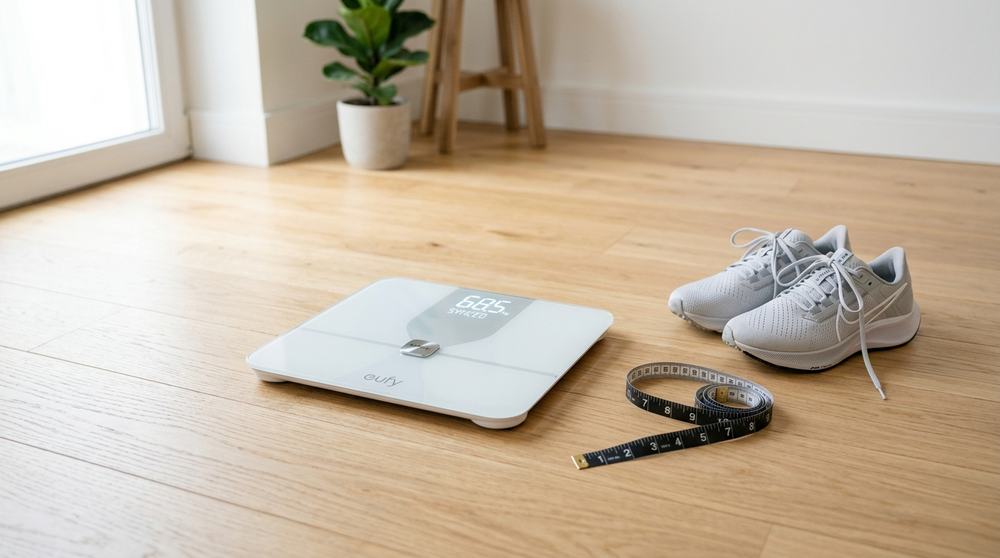
A Starting Point Only
BMI doesn't distinguish muscle from fat — use it alongside other health markers, not in isolation.
BMI Calculator
Check your body mass index
BMI is a quick screening measure based on height and weight. It does not account for muscle mass, bone density, or body composition.
What Is BMI and What Are Its Limits?
Body Mass Index (BMI) is calculated as weight (kg) divided by height (m) squared. The ratio dates from the 1830s, and Ancel Keys named it the body mass index in 1972 after finding it tracked body fat better than other simple weight-for-height indices in 7,424 men (Keys et al., 1972). It is a quick screening tool, but it cannot tell muscle from fat, so it can misclassify very muscular or very lean people.
BMI Formula
BMI = weight (kg) ÷ height (m)²
BMI = 703 × weight (lb) ÷ height (in)²
How to Calculate BMI
Body mass index (BMI) is weight divided by height squared. This free calculator uses kilograms and metres: BMI = kg ÷ (m × m). It runs in the browser. No account is required. The result is a screening number, not a diagnosis.
- Convert height to metres: Centimetres divided by 100. The form opens at 178 cm, which is 1.78 m.
- Square that height: 1.78 × 1.78 = 3.1684.
- Divide weight by that square: The form opens at 75 kg. 75 ÷ 3.1684 = 23.671, which the card prints as 23.7.
- Read the label from the cut points on this page: Under 18.5 is Underweight. From 18.5 up to 25 is Healthy Weight. From 25 up to 30 is Overweight. 30 and above is Obesity, split into class 1 (30 up to 35), class 2 (35 up to 40) and class 3 (40 and above). 23.7 is Healthy Weight.
Pounds are converted before that division, using 2.20462 lb per kilogram. The equation stays metric. Age is on the form and is not in the formula. Sex is not on the form, because the adult equation does not use it.
Healthy weight for the opening height
The healthy-range box uses BMI 18.5 and 24.9 at your height. At 178 cm that is 18.5 × 1.78 × 1.78 = 58.6 kg, through 24.9 × 1.78 × 1.78 = 78.9 kg. The opening weight, 75 kg, sits inside 58.6–78.9 kg, so the card says within range.
BMI for women and for men
Women and men use the same adult equation. A woman at 65 kg and 165 cm: height is 1.65 m, 1.65 × 1.65 = 2.7225, and 65 ÷ 2.7225 = 23.875, which prints as 23.9. That is also Healthy Weight. The healthy-weight box at 165 cm is 50.4–67.8 kg. A man at the form defaults is the 23.7 example above. Changing only the sex, if the form had a sex switch, would not move the number. It does not have one.
Age, children, and percentiles
A BMI calculator with age, for an adult, still uses kg ÷ m². This page stores the age you type and then ignores it in the math. The same 75 kg and 178 cm is 23.7 at age 28 and at age 60.
Child and teen BMI on a growth chart is a percentile for age and sex. This page does not calculate that percentile. The age box accepts 2 and up, and it still prints the adult equation. Do not read Underweight, Healthy Weight, Overweight or Obesity from this page as a child's result. Those labels are the adult cut points.
What this BMI number does not decide
BMI cannot see muscle and fat separately. A muscular adult can print Overweight or an obesity class here with a low body-fat percentage. The body fat calculator is the separate estimate. This page also does not apply Army height-and-weight tables, and it does not score a fitness test. For Asian populations, a WHO expert consultation found that risk of type 2 diabetes and heart disease rises at lower BMIs, from 22 to 25 depending on the population, and suggested extra public-health action points at 23, 27.5, 32.5 and 37.5 while keeping the standard cut-offs (WHO Expert Consultation, 2004). This calculator shows the standard cut points for every adult, so read 23 to 25 as a prompt to check waist size if you are of Asian descent.
Healthy weight for your height
The healthy-weight range is BMI 18.5 to 24.9 at your height. It is the same for women and men. A few heights, worked from the same equation as the form:
| Height | Healthy weight (lb) | Healthy weight (kg) |
|---|---|---|
| 4 ft 10 in | 89–119 lb | 40.2–54.0 kg |
| 5 ft 0 in | 95–127 lb | 43.0–57.8 kg |
| 5 ft 2 in | 101–136 lb | 45.9–61.8 kg |
| 5 ft 4 in | 108–145 lb | 48.9–65.8 kg |
| 5 ft 6 in | 115–154 lb | 52.0–70.0 kg |
| 5 ft 8 in | 122–164 lb | 55.2–74.3 kg |
| 5 ft 10 in | 129–174 lb | 58.5–78.7 kg |
| 6 ft 0 in | 136–184 lb | 61.9–83.3 kg |
| 6 ft 2 in | 144–194 lb | 65.4–88.0 kg |
| 6 ft 4 in | 152–205 lb | 68.9–92.8 kg |
BMI categories and obesity classes
| BMI | Category |
|---|---|
| Under 18.5 | Underweight |
| 18.5 to under 25 | Healthy Weight |
| 25 to under 30 | Overweight |
| 30 to under 35 | Obesity, class 1 |
| 35 to under 40 | Obesity, class 2 |
| 40 and above | Obesity, class 3 (severe obesity) |
These are the CDC's categories for adults aged 20 and over, and the CDC describes BMI as a screening measure to be considered with other factors. Children and teens use percentiles instead.
Is BMI accurate, and why is it still used?
BMI is cheap, needs only a scale and a tape, and tracks body fat reasonably well across large groups, which is why Keys recommended it in 1972 and why it is still used for screening. For one person it can mislead: muscular people can land in a higher category, older adults can lose muscle while BMI stays the same, and fat stored around the waist carries more risk than BMI shows.
A tape measure adds a lot. UK guidance from NICE uses waist-to-height ratio, with a waist under half your height (a ratio below 0.5) as the healthy range. For the opening 178 cm person that means a waist under 89 cm (35 in). The body fat calculator uses waist and neck measurements to estimate body fat directly.
Frequently Asked Questions
Sources
- World Health Organization. Obesity: Preventing and Managing the Global Epidemic. WHO Technical Report Series 894. Geneva: WHO; 2000.
- WHO Expert Consultation. Appropriate body-mass index for Asian populations and its implications for policy and intervention strategies. The Lancet. 2004;363(9403):157–163.
- Centers for Disease Control and Prevention. Adult BMI Categories.
- Keys A, Fidanza F, Karvonen MJ, Kimura N, Taylor HL. Indices of relative weight and obesity. Journal of Chronic Diseases. 1972;25(6):329–343.
- National Institute for Health and Care Excellence. Overweight and obesity management (guideline NG246).
Results are estimates for healthy adults, not medical advice. See the medical disclaimer and how these calculators work.